
TL;DR: Agentic AI is most powerful when it frees users from rigid interfaces and helps navigate open-ended reasoning spaces; the key is applying it where flexibility and synthesis matter, not everywhere by default.
Agentic AI has opened up a genuinely new way of building software.
For the first time, complex systems can be explored in natural language, workflows can adapt dynamically, and insights can emerge through synthesis rather than fixed pipelines. That shift is real, and it is thrilling for all of us working at the forefront of this progress!
At the same time, not every problem benefits equally from agentic approaches. The opportunity is not to turn everything into an agent, but to be deliberate about where agents create disproportionate value.
In practice, I tend to think about agentic AI operating across three complementary layers:
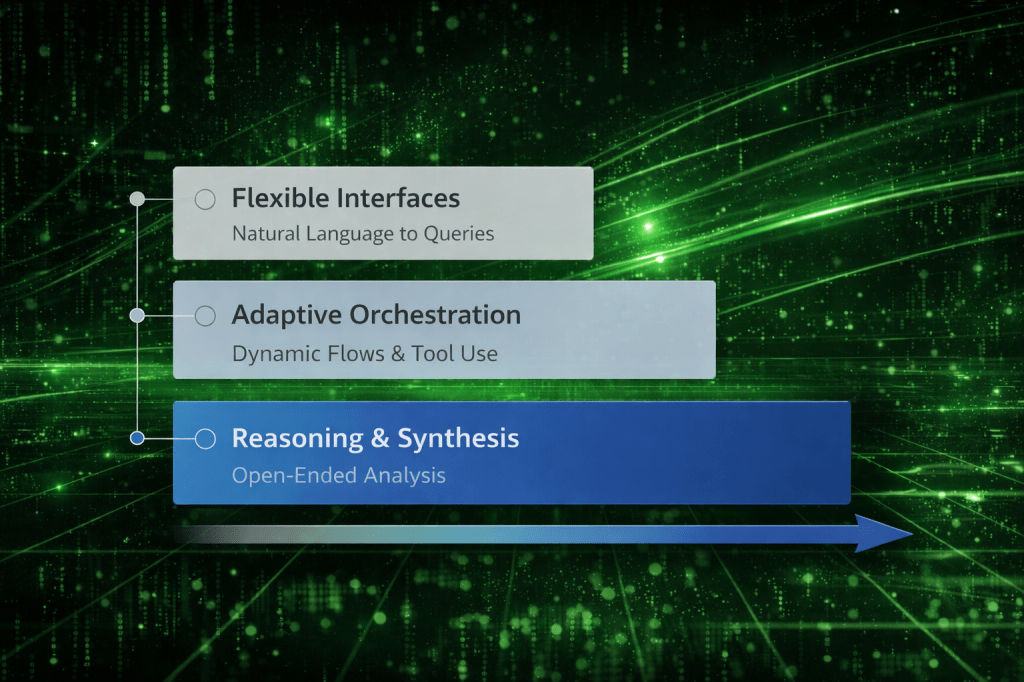
Fig 1. The Agentic Spectrum: From Interfaces to Intelligence
1. Flexible Interfaces: Unlocking Exploration
The most immediate and widely applicable impact of agentic AI is replacing rigid dashboards.
Instead of navigating dozens of filters and predefined views, users can simply express what they are looking for:
“Show me patients with fast disease progression who responded to treatment A but not B.”
Behind the scenes, this will (most likely) translate into structured queries. But the experience changes completely. Exploration becomes fluid, questions become more precise, and users stop adapting their thinking to the limitations of a UI.
I have seen teams get more value out of their data in minutes instead of hours or days simply by removing interface friction. This is the lowest-hanging fruit of agentic AI, and it is already transformative.
2. Adaptive Orchestration: Making Workflows Smarter
A layer deeper, agents start acting as intelligent orchestrators.
Here, the system decides which tools to use, which data sources to pull from, how deeply to analyse something, and when enough evidence has been gathered. The workflow exists, but it adapts to context and intermediate results rather than following a rigid script.
This is especially powerful in environments where questions evolve quickly or edge cases dominate. Instead of hard-coding every path, the system learns how to navigate the space dynamically.
This is where agentic AI moves beyond better UX and starts adding real operational intelligence.
3. Reasoning and Synthesis: Where Agents Become Transformative
The deepest impact appears when problems are truly open-ended.
In these settings, users are not simply retrieving information. They are forming hypotheses, comparing across heterogeneous sources, dealing with incomplete or contradictory evidence, and refining their understanding as they go.
There is no single predefined analytical path.
Here, agentic AI navigates an expanding space of possibilities and constructs insights that do not explicitly exist anywhere in the data. This is where agents move from automation to cognition, and where entirely new kinds of decision-support systems become possible.
Using Agents with Intention
The enthusiasm around agentic AI is well deserved. But like any powerful tool, it benefits from discipline to be used well.
I have also seen simple reporting pipelines and stable data workflows wrapped in multi-agent frameworks, only to become slower, harder to debug, and more fragile than before. In those cases, the issue was not the technology, but a mismatch between the problem and the solution.
Agentic AI shines when flexibility and exploration matter. It adds less when workflows are already stable and well defined.
A Practical Way to Think About Fit
A simple checklist I often use is:
- If users struggle with rigid interfaces, agentic AI as a natural-language layer delivers immediate value.
- If workflows need to adapt based on context, intermediate results, or evolving questions, adaptive orchestration becomes powerful.
- If insights require synthesising across messy, incomplete sources with no fixed analytical path, deep agentic reasoning is where agents truly shine.
If none of these apply, traditional software will often remain the most robust solution.
Final Thought
Agentic AI is not about replacing all software with autonomous systems.
It is about expanding what software can do.
Used thoughtfully, it unlocks fluid exploration, adaptive workflows, and open-ended reasoning that were previously impractical or even impossible to build. Applied carelessly, it can add complexity where simplicity would have been stronger.
The real opportunity is not to use agents everywhere, but to use them where they create the most impact – that is where the transformation actually happens 🙂
 Dimitrios Vitsios's blog
Leave a comment